


























This article is part of a three-article series on the Supreme Court. Read about the basics of the Supreme Court here and the recent SCOTUS case here.
What was once a unifying ratification for over a century has become a divisive debate across the nation. Birthright citizenship is the primary pathway for those born in the United States to obtain citizenship and protects children of foreign born immigrants from statelessness and deportation. As of today, U.S. citizens are divided on whether birthright citizenship extends to certain children.
Origins of birthright citizenship in the United States
Following the end of the Civil War, and the legal abolition of slavery in 1865, the Supreme Court lacked the legal pathways for the formerly enslaved to gain U.S. Citizenship. And so, birthright citizenship was born in the ratification of the Fourteenth Amendment in 1868.
What does birthright citizenship promise?
The Fourteenth Amendment of the U.S. Constitution states that “All persons born or naturalized in the United States, and subject to the jurisdiction thereof, are citizens of the United States and of the State wherein they reside.” Supporting long standing American traditions of equal opportunity, community, and non-discrimination. While recent interpretations of the historically sound document have differed, it has been the assumption that if you are born in the U.S. you are an American citizen. This is the principle of Jus soli — or the law of the soil.
Why does acquisition at birth matter?
Acquisition (or procurement) of citizenship after birth can be embodied by two basic legal principles; (1.) Jus soli which we have defined above, and (2.) Jus sanguinis — the law of the bloodline which passes U.S. citizenship from parent to child at birth.
As put by Carol Rose, executive director at the ACLU of Massachusetts, “Birthright citizenship is a cornerstone of our democracy, deeply rooted in the American legal tradition and enshrined in our Constitution.”
Nearly all U.S. citizens attain citizenship from the Fourteenth Amendment birthright citizenship clause, and without it newborns are at risk of becoming stateless and vulnerable to deportation from the U.S.
What are people saying about birthright citizenship?
Across surveys from five sources, the U.S. public seems divided on the fine print of the Fourteenth Amendment and to whom its laws apply to. Below are their respective findings:
- From December, a Public Religion Research Institute poll found a majority two-thirds in favor, “regardless of their parents’ citizenship status,” of granting citizenship
 Civic Health and Institutions Project, or CHIP50, found 6 in 10 Americans in favor of keeping birthright citizenship, (79% Democrat and 39% Republican). When looking at support rates state-by-state, they found that; “Highest support appears in the District of Columbia (68%), California (67%), New Mexico (64%), Washington (64%), and New Jersey (63%). These states combine substantial immigrant populations with Democratic-leaning electorates, though majorities persist even in politically competitive states. The lowest support levels appear in Northern Plains states: Montana (46%), Wyoming (47%), South Dakota (48%), Idaho (50%), and North Dakota (51%). Notably, these states still show near-majority or majority support.
- A poll last year from NPR/Ipsos found fifty-three percent opposed to ending birthright citizenship as of February 2025 (54%), and one in four support the measure to end birthright citizenship (28%). Ipsos, similarly, finds Republican support growing from birthright citizenship, with support for ending birthright citizenship down eight percentage points from 56% to 48% (11% of Democrats support ending birthright citizenship, while 79% oppose)
- The Pew Research Center found 9 in 10 support birthright citizenship for those born to parents who immigrated to the U.S. legally, but — by a 50%-49% margin — were divided on giving it to those born to parents who are in the country illegally, and further splits in support based on political party, race, age, and time spent in the U.S.
 According to Pew, three-quarters of Democrats support citizenship for children of those who immigrated illegally; only a quarter of Republicans supported it.
 - Regardless of political party, three-quarters of Latinos, 61% of Black Americans, 48% of Asian Americans and 42% of whites were in favor of birthright citizenship for those whose parents immigrated illegally.
 Americans under 50 were in favor of birthright citizenship if the parents “immigrated illegally” by a 58%-41% margin, but approximately 6 in 10 of those 50 or older were against it.
- Second-generation Americans are more likely than third or higher-generation Americans to support birthright citizenship for children of illegal immigrants (67% and 45% respectively)
- A YouGov poll from February 2025 found that 51% of U.S. citizens believe all children born in the U.S. should automatically become citizens, with 39% saying “only if their parents are citizens.”

What can numbers tell us? Divisive statistics
Recent arguments against birthright citizenship often revolve around overarching attempts to limit illegal immigration and preventing “birth tourism,” which is when immigrant mothers come to the U.S. with temporary visas specifically to have their newborn secure U.S. citizenship through birthright citizenship.
The question is; are these concerns warranted by birth rates from immigrant mothers overall?
The Pew Research Center analysis approximated how many children are born to unauthorized immigrants or legal temporary immigrant mothers as of 2023. They found roughly 9% (320,000 of 3.6 million) of babies born in the U.S.
Pew also emphasized that less than 1% of births in 2023 (9,000) were from “birth tourists” (defined above) according to the National Center for Health Statistics in 2023.
While the numbers appear unalarming to some, an NPR article on birthright citizenship notes Daniel Epstein of America First Legal disputes; numbers are irrelevant, “I view just one illegal act as illegal, and birth tourism is illegal and it’s against the law, and the law matters.”
Birthright citizenship today
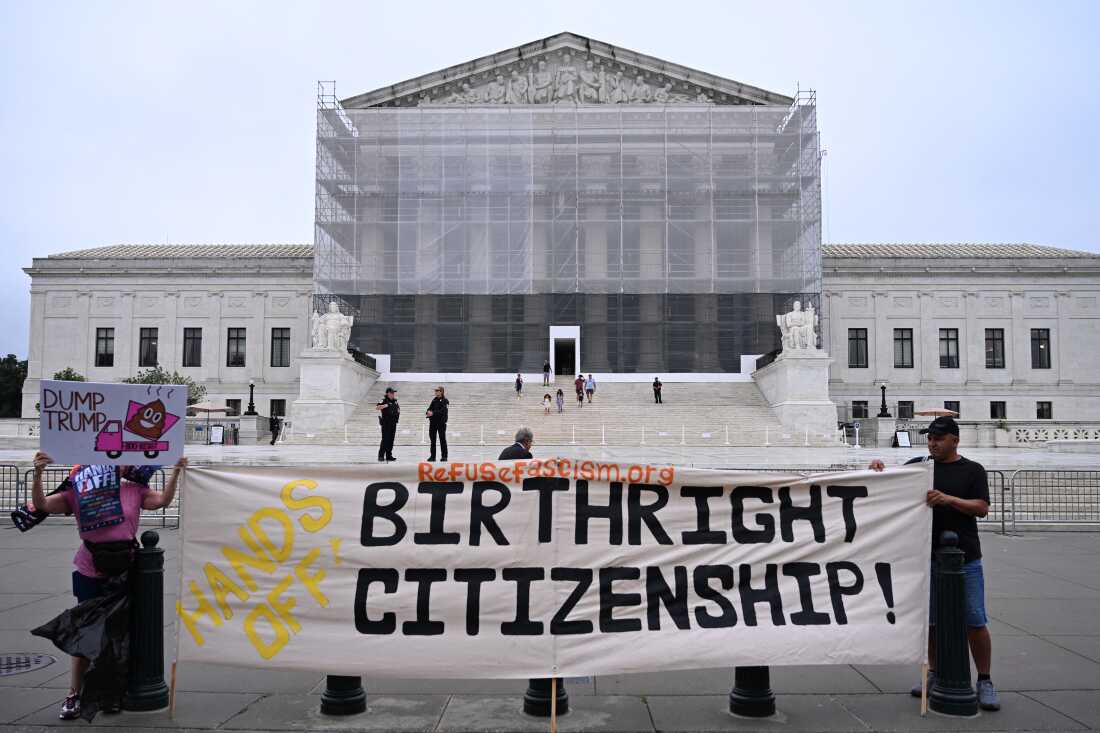
While it is all well and fine to debate topics, even good to question policies from time to time. How often are public debates welcomed to the Supreme Court? As of September 2025, birthright citizenship is currently under review by the Supreme Court following the Trump Administration’s executive order against birthright citizenship for the babies of undocumented immigrants and any lawfully present immigrants without green cards. It is uncommon to see such a relevant example of a Constitutional reevaluation like this one. Seizing this opportunity is crucial, learning more about how the U.S. government and the U.S. legal systems work, as well as real world impacts of certain policies is a necessary skill to survive in society.