













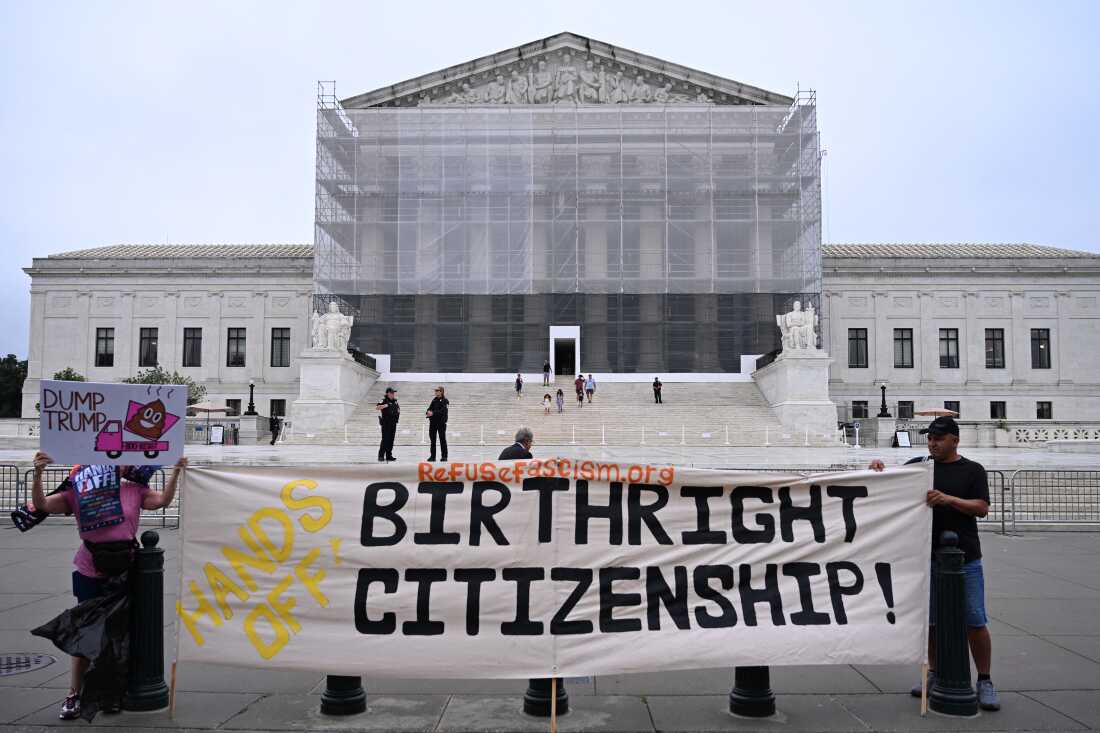
This article is part of a three-article series on the Supreme Court. Read about Birthright Citizenship here and the basics of the Supreme Court here.
Trump v. Barbara has become a widely publicized court case, picking up ground as it made its way to the Supreme Court. Oral arguments have been heard, and now everyone awaits the results of the conference due by late June. The controversial topic yields divisive opinions across the nation, the U.S. is on edge, the question is what will happen next? Amongst grand court cases, the power is in knowledge and voice. One must learn and advocate for what they believe is right. Starting now.
What’s Trump’s case against birthright citizenship?
On January 25, 2025, one of Trump’s many Presidential Actions began a legal attack on the applications of birthright citizenship. Below is an excerpt from the order on birthright citizenship.
It is the policy of the United States that no department or agency of the United States government shall issue documents recognizing United States citizenship, or accept documents issued by State, local, or other governments or authorities purporting to recognize United States citizenship, to persons: (1) when that person’s mother was unlawfully present in the United States and the person’s father was not a United States citizen or lawful permanent resident at the time of said person’s birth, or (2) when that person’s mother’s presence in the United States was lawful but temporary, and the person’s father was not a United States citizen or lawful permanent resident at the time of said person’s birth. (Protecting the Meaning and Value of American Citizenship).
Separate interpretations of the order across the board, some outlets believe that the order on birthright citizenship “is part of his Republican administration’s broad immigration crackdown,” (PBS) and to “view the order, and the high court’s consideration of the case, as a key component of [Trump’s] hard-line immigration agenda — an issue that has become a defining feature of his second White House term” (Fox News).
However, explicit support for the Trump Administration can be found, reaffirming his earlier argument.
But this all-important case should be open and shut: the Constitution’s text and history are on the president’s side. Nothing in the Constitution requires the government to give citizenship to the children of illegal aliens. The case centers on the 14th Amendment’s citizenship clause, which states that ‘all persons born or naturalized in the United States, and subject to the jurisdiction thereof, are citizens of the United States.’ The key phrase in dispute is ‘and subject to the jurisdiction thereof.’ A plain reading of the grammar (‘and’) shows that birthright citizenship requires two conditions, not just being born here. (Fox News).
Making it to the Court
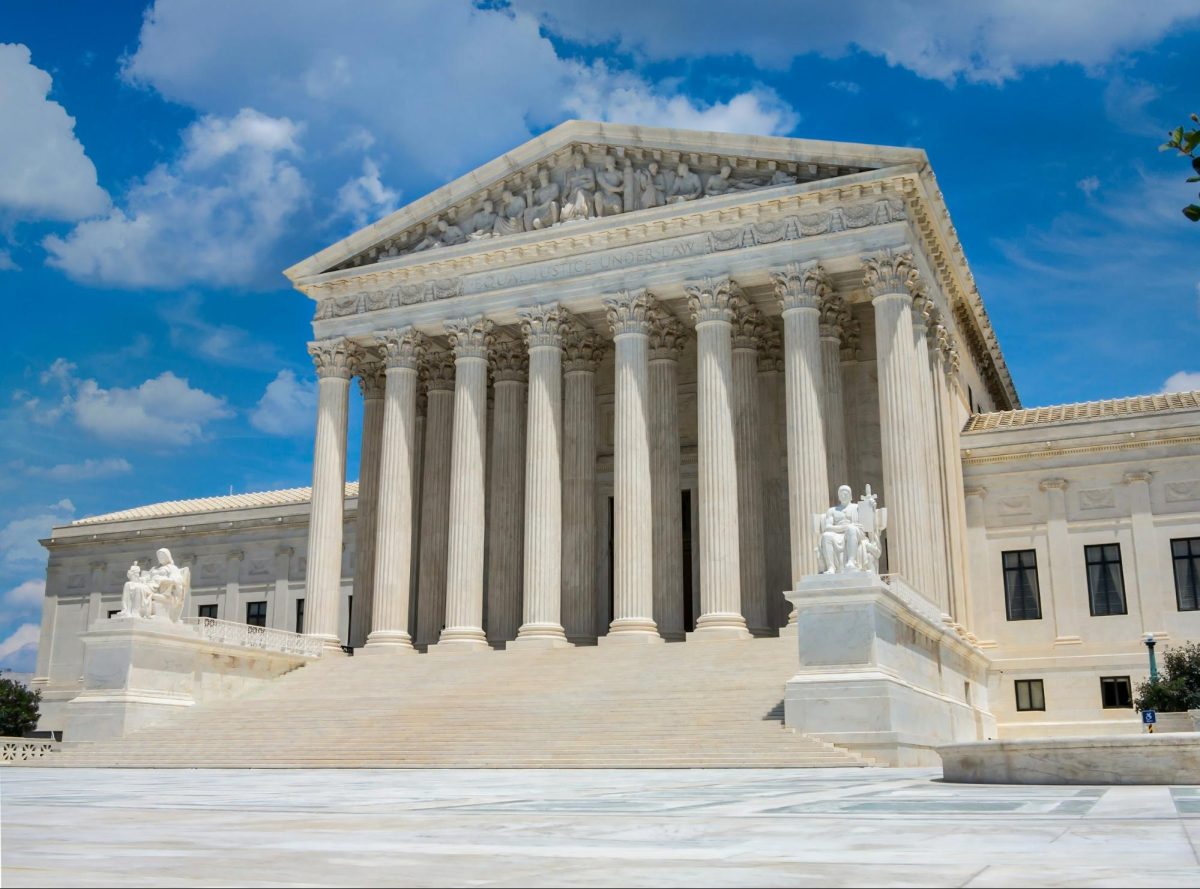
In April, first 2026 oral arguments of Trump v. Barbara was finally heard in the Supreme Court. The government is represented by Solicitor General John Sauer, the plaintiffs are represented by legal director of the American Civil Liberties Union Cecillia Wang. PBS notes that “Every lower court to have considered the issue has found the order illegal and prevented it from taking effect.”
Following Trump v. Barbara
During oral arguments, Sauer highlights that the government is “not asking [the Supreme Court to] overrule Wong Kim Ark,” but that the 1898 ruling clearly related to “domiciled aliens,” not “sojourners,” or temporary visitors. Much of Sauer’s argument revolves around this term; domicile, which is someone’s permanent residence and shows true “allegiance.” Sauer reasons that “citizenship to the newly freed slaves and their children [post Civil War], whose allegiance to the United States had been established by generations of domicile here,” did not “grant citizenship to the children of temporary visitors or illegal aliens who have no such allegiance.”
Wang counters, “in America we do not punish children for the sins of their fathers, but instead we wipe the slate clean. When you’re born in this country, we’re all Americans, all the same.”
Going forward, the Trump administration will have to persist amongst the skepticism of the justices. The second justice to weigh in, Chief Justice John Roberts, implied that the Trump administration’s arguments were “quirky,” and when Roberts asked about any data on how many people come to the U.S. for “birth tourism,” Sauer responded “No one knows for sure,”citing numerous “media estimates.” Throughout the lectern, Justice Gorsuch said that it was “striking” to him how infrequently the keys to Sauer’s argument; allegiance and domicile were discussed during the 14th amendment congressional debates, citing Justice Marshall Harlan, who— years after he dissented in Wong Kim Ark — unambiguously stated that the court’s ruling in the case covered temporary visitors to the United States. Roberts remarked as well, “It’s a new world, [but] it’s the same Constitution.”
It’s not an April Fools joke, birthright citizenship is officially under deliberation in the Supreme Court. Now every U.S. citizen must play the waiting game.
What is the nation saying about the trial?
Trump v. Barbara is facing some mixed reviews, and there are numerous problems outlets are finding with the presidential order.
First up is legal affairs correspondent Nina Totenberg at NPR, “Indeed, even as both Republican and Democratic administrations have sought in modern times to deport large numbers of individuals who have entered the country illegally, the notion of birthright citizenship has remained so entrenched that during World War II when Japanese citizens were held as enemy aliens in U.S. detention camps, their newborn children were automatically granted American citizenship because they were born on U.S. soil.”
It is important to remind readers that a two-thirds majority in Congress and a three-fourths majority of ratification by the states is required to repeal an amendment. This is an example of one of the checks on Presidential power, effectively ensuring that Constitutional amendments cannot be repealed by executive orders.
Checks and balances are worth noting because, as Campaign Legal Center communications associate Emily Burns puts it, “Not only does the president have no power to strip citizenship rights from American-born individuals, his attempt to do so is an insult to our constitutional tradition. Citizenship based solely on place of birth opens democratic participation to all and rejects the fundamentally undemocratic concept of citizenship based on race, class, heritage or parental immigration status. For the president to say he will unilaterally deny citizenship to certain people born in the country is incredibly troubling, both as a matter of law and because of what it means for democratic participation. If the president has the right to determine who is and who is not a citizen, then the president also can decide who can and who cannot vote — and that is a very dangerous precedent.”
In the same article, Burns further concludes that “Attacks on citizenship are attacks on our democracy. From trying to upend the electorate by eradicating birthright citizenship to signing an executive order that would require difficult-to-obtain citizenship documentation to register to urging the passing of dangerous anti-voter legislation, President Trump is attacking the freedom to vote.”
In all three statements, valid concerns are raised against Trump’s presidential order. Understanding the full scope of policies, ratifications, etc. is a necessary skill moving forward.
“My child is now a political debate,” The ramifications of Trump’s presidential order
Trump’s presidential order has the power to strip thousands of children of birthright citizenship, essentially leaving them stateless and vulnerable to deportation. This presents as a two-tiered society, “creating a new subclass of people lacking the full rights and protections long enjoyed by citizens,” (Samuel Breidbart & Maryjane Johnson, Brennan Center for Justice).
Furthermore, the United Nations Refugee Agency has noted, people who are stateless often lack access to basic rights and services (such as health care, education, and the ability to travel freely).
Brennan Center for Justice’s article emphasized that “empowering government officials to question people’s citizenship status, the order opens the door to discriminatory and arbitrary government interference in people’s daily lives…. everyone would be vulnerable to having their citizenship questioned.”
Justice Sonia Sotomayor takes it a step further during oral arguments on April first, proposing that the administration’s logic opens doors to further possibilities and could allow a future president to try to strip citizenship from U.S.-born children years from now.
The reality is, not only are there ramifications at a great scope, there are personal stories with personal worries. People are scared, and nervous to see what the future holds for their children.
“I hope that she feels safe in this country…. I’m thinking about whether she can speak freely in this country, whether she can talk about her identity freely, whether she can talk about her parents not being citizens. That she can do what she really wants to in terms of her career and education.” (From a father of two who faced uncertainty around the birth of his daughter, Hibah Ansari & Lora Strum, ACLU)
Takeaways
Birthright citizenship affects thousands of lives, and has given opportunities to countless more. This is a controversial topic with differing opinions and opposite sides, it can feel difficult for individuals to advocate for themselves and their voice during times like these. It is easy to write off individual roles as insignificant, but Rome wasn’t built in a day and change won’t be easy. Whether one supports Trump’s Presidential order or they disagree, it is within everyone’s power here in the U.S. to voice their opinions. While not included in the fourteenth amendment, it is the first. Take in multiple perspectives, do research, gain knowledge, and believe in the power of advocacy. If everyone does this, a real change can come; there is a power in numbers, and there is a power in each individual.